Anzeige

Managing conflict and effective dispute resolution in higher education, CP

Organisation:
Universität für Weiterbildung Krems
City, country:
Krems, Lower Austria, Austria
Type:
part-time
Certificate:
Cert. (Certificate)
Duration:
2 semester(s)

The Programme

The Certificate Programme (CP) addresses the growing demand for professional conflict management in higher education. Currently, no formal training exists in Europe for this complex role. The CP fills this gap by offering structured learning for both aspiring and experienced ombudspersons and professionals dealing with student complaints or stakeholder conflicts.


Participants gain a solid grounding in higher education governance and the legal and ethical frameworks of ombuds work (confidentiality, data protection). They develop essential transversal skills - such as strategic negotiation, communication, and self-reflection - and learn to apply techniques in alternative dispute resolution. The programme emphasizes peer learning, joint case analysis, and peer coaching, creating a strong network of practice.

It prepares participants to navigate the sensitive role of intermediaries, advocate for fair policies, and use conflict as a driver for institutional learning and change. The CP offers a unique pathway for mastering the challenges of ombuds work and contributing to the professionalization of this vital field.


Target Group

The programme is aimed at individuals in higher education who are responsible for handling complaints and resolving conflicts between stakeholders. This includes both explicitly designated ombudspersons as well as professionals dealing with student complaints and/or discrimination cases in other roles, such as diversity management, student counseling, and academic units. The diverse professional backgrounds and levels of experience among participants are essential for achieving the programme’s learning outcomes.

©Walter Skokanitsch

Modular Structure

Higher education governance and the legal framework for ombuds work
Module 1 provides a foundational understanding of governance structures and legal frameworks relevant to ombudspersons in higher education and others working in similar areas. Participants will analyze organisational and stakeholder dynamics within higher education institutions and the larger European Higher Education Area and develop the competencies to address legal and ethical challenges in their work, with particular focus on confidentiality, privacy, whistleblowing, and non-discrimination.

Communication and negotiation in higher education
Module 2 develops advanced communication and negotiation skills tailored to the university context, enabling participants to navigate difficult conversations and stakeholder dynamics. The module emphasizes empathetic listening, strategic dialogue, and interest-based negotiation approaches. It is designed for those managing complex interactions and aiming to build trust in institutional environments.

Conflict resolution and ADR techniques in higher education
This module focuses specifically on dispute settling and conflict resolution in the context of higher education as the core responsibility of ombuds. Learners will analyse conflict sources, understand conflict management systems and recognise cultural and contextual differences. The module provides learners with concrete ADR techniques they can apply in their work; participants will learn how to support stakeholders effectively, how to encourage proactive conflict management and how to promote institutional learning.

Reflective practice: self-management and case-work
In the CP’s concluding module, participants will apply the learning outcomes of the previous modules to work together on actual cases and devise solutions. Moreover, the module aims to foster the reflective, emotional, and interpersonal competencies essential for ombuds in higher education. Participants will develop strategies for stress management and self-care while enhancing their own resilience and empathy. Leveraging peer-learning and collaboration, the module emphasizes the importance of peer-support net-works in sustaining professional effectiveness in high-pressure environments. Through interactive workshops and case-based group work, participants will analyze complex real-world challenges from their own backgrounds, reflect on critical incidents, and develop collective solutions to systemic and interpersonal issues in higher education

©Walter Skokanitsch

Admission Requirements

Applicants must meet one of the following criteria:

  • A completed university degree (minimum of a Bachelor's degree),
  • OR A general university entrance qualification and at least one year of relevant professional experience in dealing with (student) complaints and/or conflict management within higher education institutions,
  • OR A minimum of two years of relevant professional experience as an ombudsperson or in a comparable role involving conflict and complaint management in higher education settings.
Travel and accommodation costs may be covered through Erasmus+ staff training (higher education) funds, provided that the mobility is approved by the applicant’s home institution and the relevant conditions are met. Please note that tuition fees are not eligible for funding. For details, please refer to the Erasmus+ Staff Training information. We are happy to support you in the application process where possible.

Costs

EUR 4.200,--

Request Information material

Order information material from Universität für Weiterbildung Krems. The given data is transmitted only to this educational provider and, of course, not given to a third party.

I want:

Organisation

The University for Continuing Education Krems is the leading public university for continuing education in Europe. As university for continuing education we specialize in enhancing the qualifications of working professionals. The strength of the university is providing university courses that keep pace with the times and are oriented toward current and future societal challenges. Almost 8,000 students are currently enrolled in the University for Continuing Education Krems, more than 30,000 have already completed their studies successfully. The university combines ongoing innovation in research and teaching with the highest standards and holds the seal of quality of the Agency for Quality Assurance and Accreditation Austria (AQ Austria).

©Walter Skokanitsch
 

Programs of Study
The University for Continuing Education Krems provides Master’s programs and shorter courses in the following areas:

  • Arts & Culture
  • Building & Environment
  • Digitalization & Sensors
  • Economics & Business Management
  • Education
  • Health & Medicine
  • Law & Administration
  • Media & Communication
  • Migration & International Affairs
  • Psychotherapy & Social Services

Please find our complete study program in our course catalogue.

Studying in Krems

The range of studies offered by the University for Continuing Education Krems is specially designed to meet the requirements of adult students. It gives students the opportunity to complete academic continuing education alongside their careers, thereby acquiring competencies for professional and personal ongoing development. There are specific admission prerequisites, depending on the type of study and the subject area of the course, which you can find out about in the respective course at www.donau-uni.ac.at/study

©Walter Skokanitsch

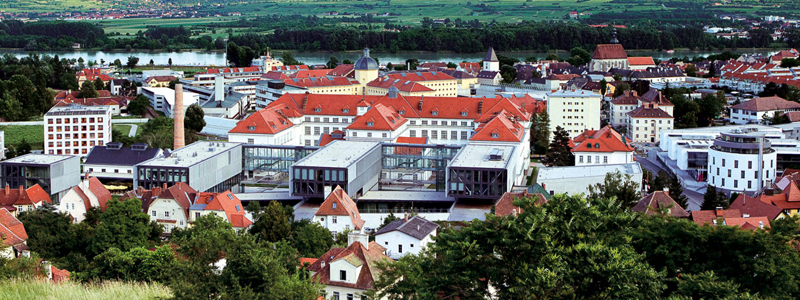
Campus Krems is equipped with state-of-the-art teaching and research facilities, comfortable accommodations, a varied range of food services, and an arthouse cinema. It offers the ideal environment for learning, research and living.

Universität für Weiterbildung Krems

Dr.-Karl-Dorrek-Straße 30
3500 Krems
Austria